Monday, March 25, 2019

“To Stretch or Not To Stretch”: Continued Progress

“Improved Blood Flow

Circulation of blood throughout the body allows oxygen and nutrients to be transferred to the organs and muscles for proper function, strength, movement, and flexibility. In turn, this reduces muscle soreness.


Cons:

Improper Technique

Not knowing how to properly stretch can lead to body aches and pain. Having the wrong form for a stretch positions the body in a way it would actually cause harm instead of benefit. For example, when reaching down to your toes with both hands it is important to keep the back straight. Bending or arching it will create tension and discomfort in the future.


Prolonging Stretches

There is misconception that there is a correlation between the amount of time you hold a stretch to the amount of soreness that is avoided the next day. However, excessively stretching does not prevent soreness at all; it makes you more susceptible to injury. Holding your muscle in one position should never exceed more than 30 seconds.


Incorrect Stretching for Exercises

Stretching is not as simple as it appears. From ballistic, dynamic, passive, and static, the list continues on for the different types of stretching that exists. They each have their own purpose. Whereas dynamic would benefit an athlete more than a bodybuilder, static stretches better reward the latter over power-driven workouts.


Conclusion: Stretching is individualistic. Each person needs to focus and listen to their body’s needs. If performing high-impact workouts, it may be necessary to incorporate stretching into your exercise session. The type of stretch conducted for the activity is more important than stretching at all. Improper stretches will be less beneficial as they actually predispose the body to injury. Overall, individual fitness goals influence what is needed. You need to make the smart, informative decision on whether or not stretching is for you.”

I feel as if I will need to add to the conclusion or to the article overall once I create the layout for the magazine article so I will be working on that next so I can create it and finalize it. 

I also plan on getting the pictures soon for the magazine. The amount I need will be finalized once I make the layout but the concept should wil all be the same. It will involve one singular person doing the stretches or not stretching at all. This will keep the message direct, while not making the page too hectic. They will probably be placed along a white background and wear light, bright colors. The mis-en-scene will be discussed in its own blog once the pictures are created. 

Saturday, March 23, 2019

"To Stretch or Not To Stretch" Progress

This is the draft to the article I am writing.

"To Stretch or Not to Stretch

Subheading: Feeling pain before, during, or after your workouts? There’s a reason why, and it might not be the answer you’d think.

Intro: Stretching is the act of extending a certain muscle or body part to its full-range. The stigma attached to the word, “stretching,” assumes it is a necessary step in a proper, healthy workout routine. It tends to take up at least ten minutes from your training; this article will take you the same amount of time, but will save you years of poor training techniques and body aches. However, stretching will not have the same beneficiary impact for an individual depending on their fitness goal. We will expose the advantages and disadvantages to stretching in order for you to access the prominent question: to stretch or not to stretch?

Pros:

Increased Flexibility
This is everyone’s go-to explanation for why stretching is essential, and everyone who says so is correct in their assertion. Flexibility improves performance because the joints are moving in a full-range motion, in turn lowering the risk of injury.


Decreased Pain
Lengthening the targeted body parts reduces the tendency to stiffen. Overall, the motions made in exercises avoid the pain commonly associated to torn, or pulled, muscles. This supports strength gain as muscular tension is reduced, which tends to inhibit the muscle’s growth after training.


Improved Blood Flow"

I want to do three for each and a conclusion at the end explaining stretching depends on the types of stretches and each individual's fitness goals.

Friday, March 22, 2019

Changes Made to Contents Pages

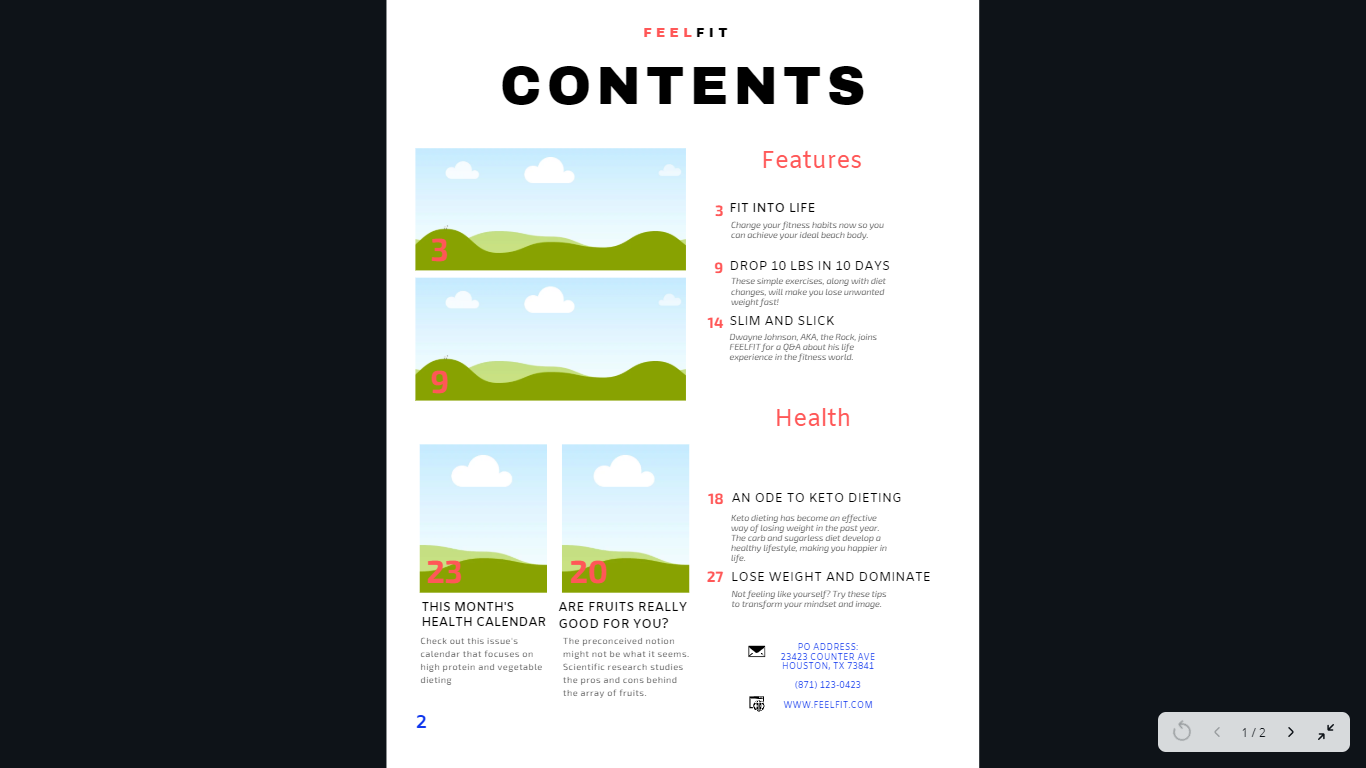
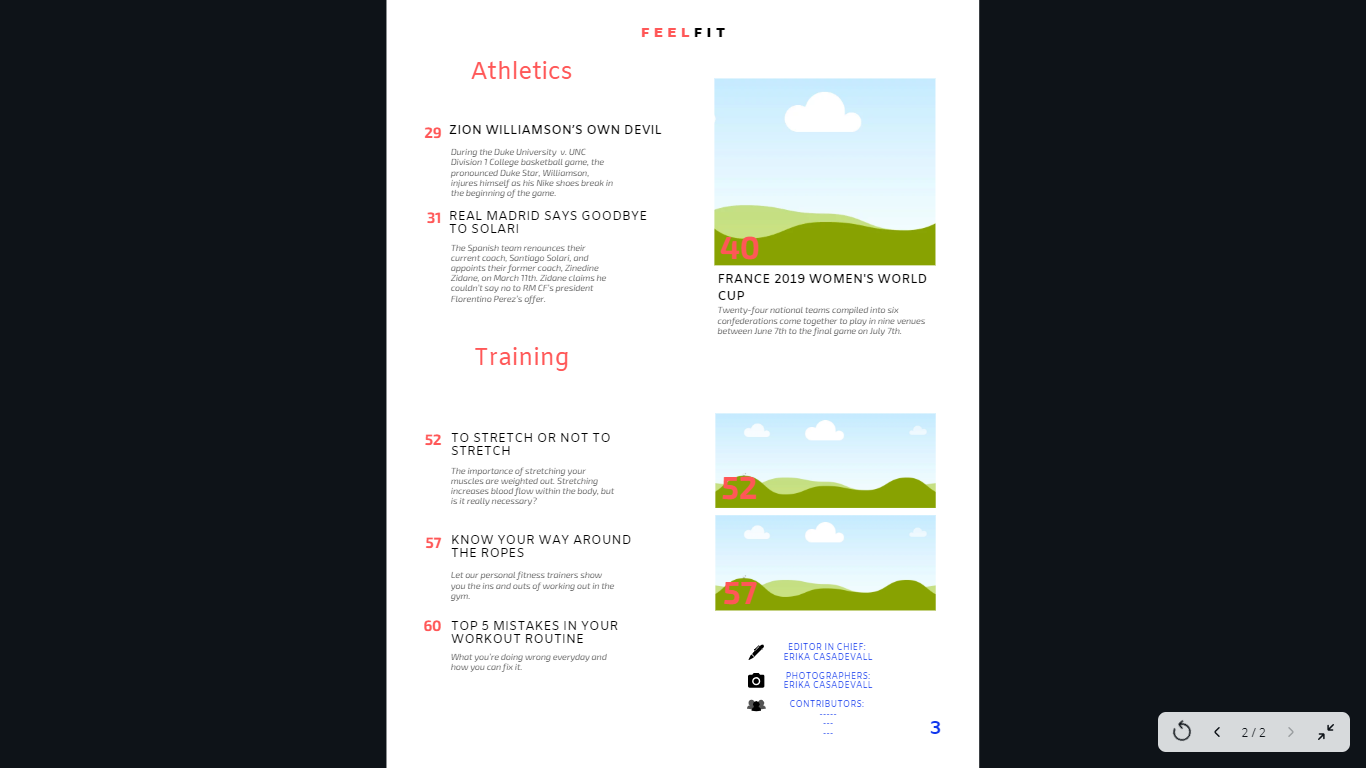
After briefly discussing my finished Contents page with another individual, I was given feedback that I was missing the page number on the individual pages. Since the pages are placed side by side, it would look better if the page numbers were placed on the left bottom corner for the first page and the right bottom corner of the second page. To contrast from the rest of the black and red color scheme, I used the same color blue #00c4cc (the code for the specific color) I had used for the information tabs. Here is the completed contents for the magazine, missing the images still.

First page to the Contents. It is placed immediately after the Cover Page of the magazine; therefore, it will be page number 2.

Second page of the Contents. It is placed beside the first page of the Contents; therefore, it will be page number 3. 

Thursday, March 21, 2019

Topic of my Two-Page Spread: Stretching


The article I decided to focus on for my two-page spread is “To Stretch or Not to Stretch.” I want to layout my article as a pros vs. cons page where the effects of stretching are introduced, such as stimulation of blood flow throughout the body, flexibility being increased, etc

I researched stretching before and after exercising and I think I want to incorporate them both and make it a collective article focusing on stretching overall. I will make a list of the two with concepts I’d like to describe below.

Stretching effecting the active body:

Pros

-Increased flexibility
-Improves performance by joints moving in full range motion
-Lowers risk of injury
-Lengthens muscles
-Reduces tendency to stiffen
-Supports strength gains
-Decreases pain

Cons

-Incorrect type of stretching before certain activity
-Static stretching may cause injury
-Prolonging stretches
-Cold muscles held in stretching positions may cause injury
-More than 30 seconds is excessive
-Doesn’t prevent soreness


Overall advice for the article:
-Stretching is individualistic
-Focus and listen to your body’s needs
-The type of stretch for activity is more important than stretching at all
-improper stretches will be less beneficial
-For power-driven workouts, dynamic over static
-individual fitness goals influence what is needed

Tuesday, March 19, 2019

Finished the Two Content Pages!


The contents page of the magazine is finished with the layout and information, such as the correct page numbers and article titles. The four different areas, features, health, athletics, and training, each have at least three articles. Each area has at least one picture. I included the location of the PO address and contact information, website URL, editor in chief, photographers, and contributors at the bottom right of the page in blue color to contrast from the red and black, while keeping the color scheme to the theme. The contributors list will be added to once the people photographed for the images are made.


Sunday, March 17, 2019

Coming Up With the Article

I have to finish creating the other layout and I will make a blog post about it. This week coming up I want to work on the article, meaning I need to decide what I can do. Since I don’t have the pictures yet, I am not limited to a certain topic of Health, Training, or Athletics. To narrow it down to three topics, it would be:
-Health: An Ode to Keto Dieting
-Training: How to Avoid Muscle Cramping
-Training: To Stretch or Not to Stretch

The last two would be the easiest to photograph images for. For example, #2 would include a demonstration of someone going through the steps of avoiding a muscle cramp. So, stretching, drinking water, taking magnesium and potassium, rolling out the muscle, etc.

The third would consist of individual stretches and their effects on the body.

Thursday, March 14, 2019

Contents Page Two

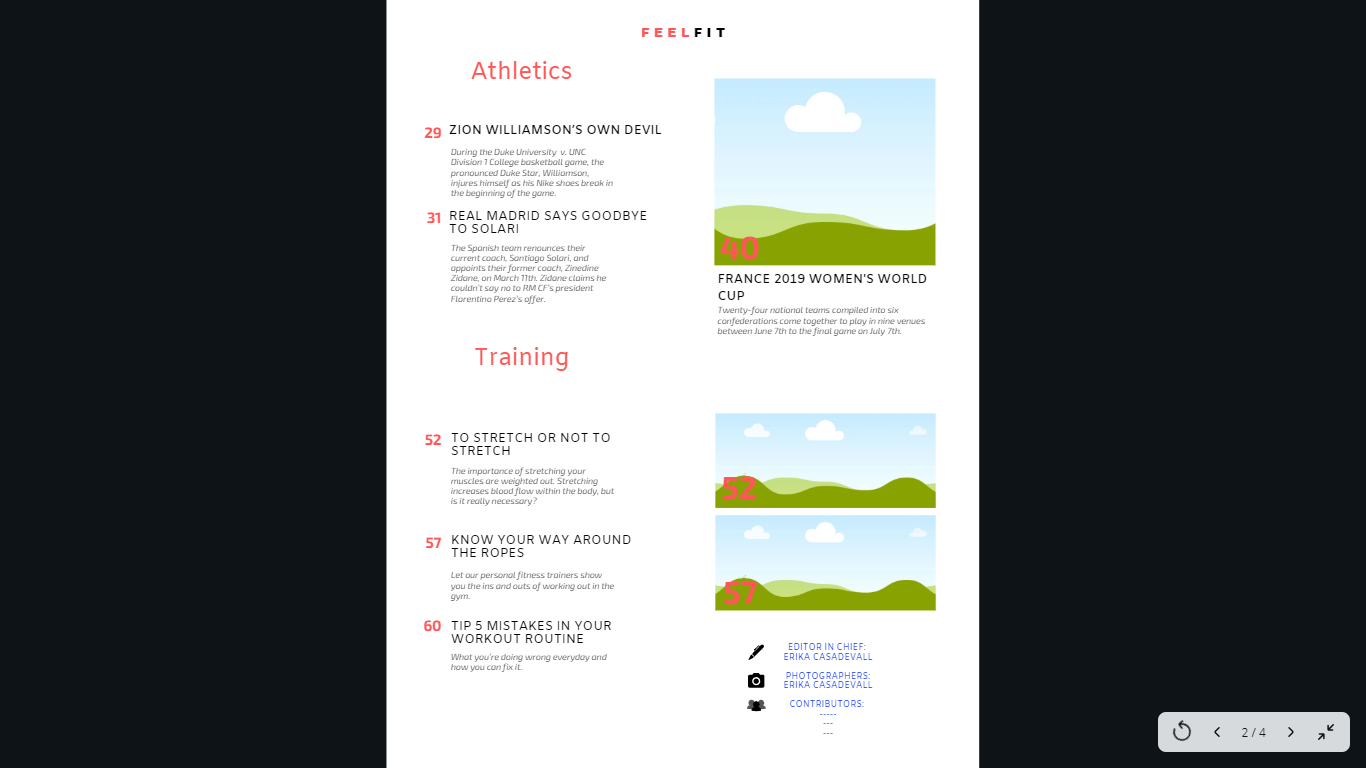
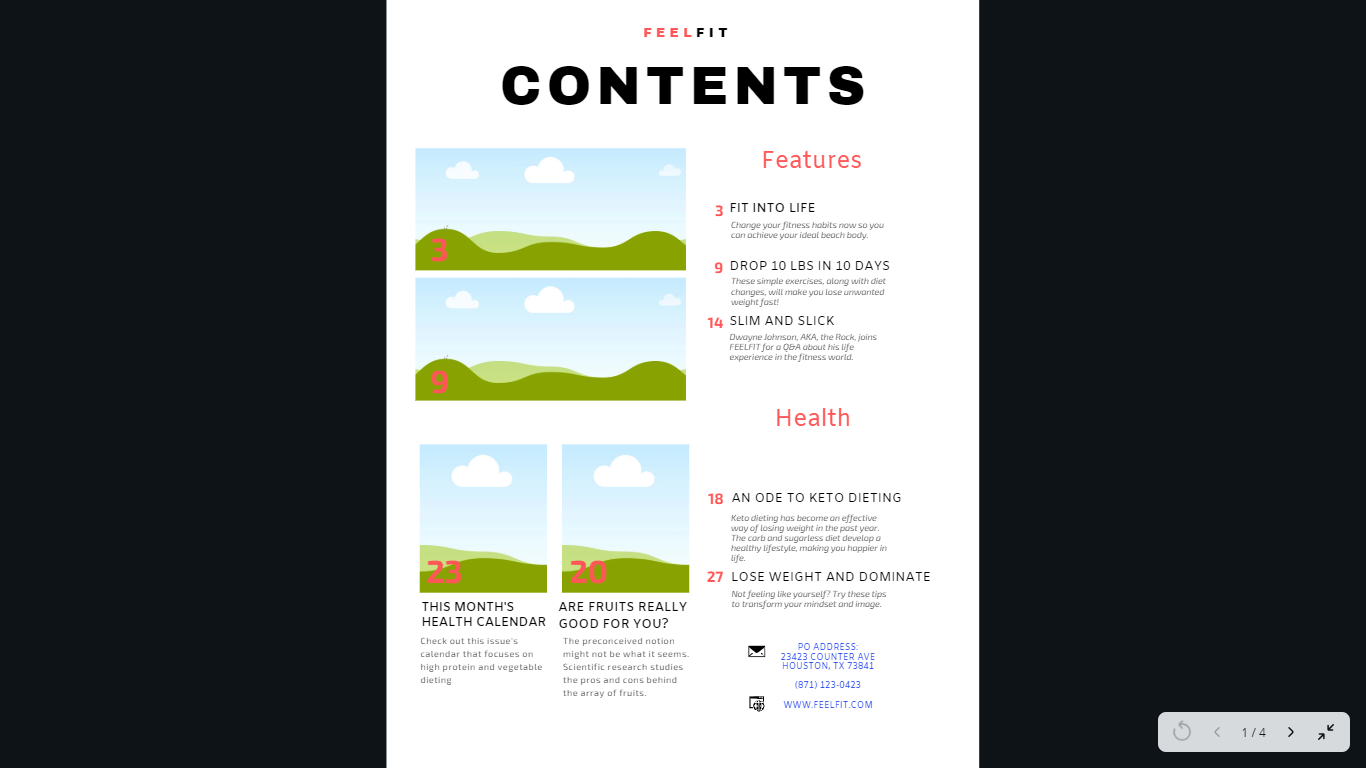
I had some brief ideas of how to set up the second page of the table of contents. I am currently in the middle of designing two. One of the keeps the text all along the left side column and pictures on the right side, whereas the other one uses a combination of the two. My issue with the ladder is that the first table of contents page keeps everything nicely ordered and isn’t confusing to read through because the text is all aligned on the right side of the page. Pairing the first page with the first idea I had for the second page will keep all the text in the center focus of the magazine with the pictures surrounding it, which is the opposite of the cover page. This alludes to the magazine being open, since the contents is the first page.

This is the image of the combination of the images on both sides, mostly focusing on the layout rather than the information since it is a copy from the first page in order to avoid having to remake text boxes with their specific color, font, and size. It is time-efficient simply to align them.

I have to finish creating the other layout and I will make a blog post about it.